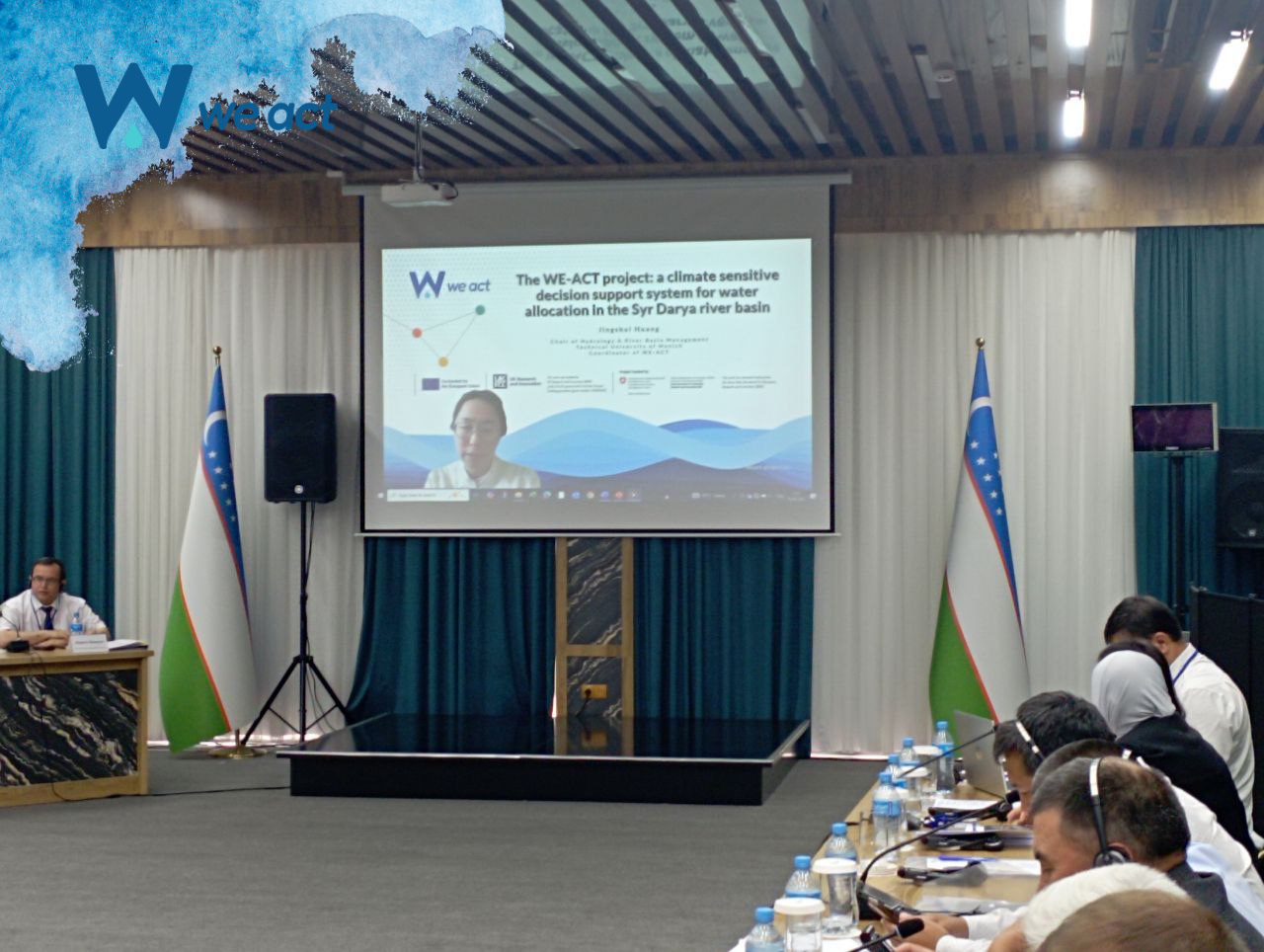
This was the central question at Science for the European Water Resilience Strategy, held in Brussels on 8 October 2026. Co-organised by WE-ACT and TRANSCEND, the event brought together 14 research and innovation projects, European Commission representatives, water managers and researchers. Forty-eight participants attended in person and 64 joined online.
The programme focused on three connected issues: data-driven water management, water scarcity and governance. Across the sessions, projects presented tools and approaches for improving water data, assessing future risks, managing competing demands and supporting cooperation across sectors and borders.
Connecting data with decisions
WE-ACT offered a concrete example from the Naryn and Kara Darya catchments of the Syr Darya basin, covering parts of Kyrgyzstan and Uzbekistan. The project combines monitoring stations, modelling, a data warehouse and a decision-support system to help water managers examine water availability, demand and allocation options.
Presenting WE-ACT’s work, Ivan Rocabado of HAEDES explained how shared evidence can support dialogue between countries that depend on the same river. By working with the same data and future scenarios, stakeholders can compare options and discuss the consequences of different allocation choices.
“Water diplomacy is possible because the numbers guide the conversation,” he said.


Understanding scarcity across the water system
Other projects extended this perspective. RECREATE highlighted the importance of making digital water tools interoperable so that data and models can be reused across regions. SOS Water and RETOUCH NEXUS showed how water decisions can affect agriculture, energy, ecosystems and the economy at the same time. AWARD examined the conditions needed to bring water reuse, rainwater harvesting and managed aquifer recharge into wider practice. GOVAQUA and InnWater focused on the institutions, partnerships and stakeholder involvement needed to support implementation.
TRANSCEND added the experience of its work in Crete, where researchers began by listening to farmers, water managers and local authorities. This process helped build trust and encouraged stakeholders to continue working together beyond the original project.
What policymakers need from research
European Commission representatives connected these contributions with current European priorities. Joachim Maes, team leader in the Commission’s Sustainable Freshwater Management unit, highlighted the importance of making research tools available to water managers, improving information on water use and supporting the digitalisation of the water sector.
The governance discussion added a practical dimension. Research recommendations should identify specific gaps in existing arrangements and explain how they can be addressed. Participants also recognised that water resilience involves choices between agriculture, energy, ecosystems and communities. Better evidence cannot remove these trade-offs, but it can make their consequences clearer and support more transparent decisions.
Continuing the exchange
The event created a direct exchange between research projects and policymakers. Researchers gained a clearer understanding of the information and approaches needed for policy implementation, while policymakers were able to examine tools and methods already being tested in different regions.
For WE-ACT, the meeting provided an opportunity to bring experience from transboundary water management in Central Asia into the European policy discussion and to explore how research results can remain useful beyond the lifetime of an individual project.